

Robert S. McNamara was one of the more brilliant minds of his generation, serving as the President of Ford Motor Company and the World Bank. However, he will be best remembered as one of the most controversial figures of the Vietnam War while serving as the Secretary of Defense to both Presidents Kennedy and Johnson.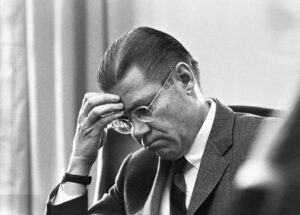
William Taubman and his brother Phil have written a book that brings significant new insights into the life and mind of Robert McNamara. It is title “McNamara at War; A New History”. William joins us for a conversation.
During the Second World War, McNamara served in the Army Air Corps Office of Statistical Control. During that time, he “Analyzed campaigns to make them more efficient – not in terms of killing more but in terms of weakening the enemy.” While some of his recommendations, like having the bombers fly at lower altitude, were not popular with the air crews, Curtis LeMay did respect and adopt many of his recommendations. We discuss how this experience might have led McNamara to his infamous “body count” decisions during the Vietnam War.
When McNamara somewhat reluctantly accepted President Kennedy’s to serve as Secretary of Defense, he walked away from a $3 million a year salary at Ford for a $25,000 per year salary as Sec. of Defense.
William and Phil propose that neither McNamara nor Johnson believed the Vietnam War could be won, but they operated within an echo chamber, each convincing the other.
William discusses McNamara’s very close relationship with Jackie Kennedy and Bobbie Kennedy. Bobbie was quoted as saying the McNamara was so persuasive that he frightened him a little.
We review the 10 points for victory from McNamara’s book “In Retrospect”. Toward the end of his life, McNamara lamented that if more leaders had read his book and taken the lessons to heart, we could have avoided losses of life in contemporary conflicts.
TAKEAWAY: After reading the book, I would categorize McNamara’s life as a Shakespearean tragedy.