

The Thunderbird was the insignia used by the 180th Infantry Regiment during WWII. They engaged in some of the heaviest fighting during the War, from North Africa to Sicily. The 180th then fought their way north through the Vosges Mountains of France, where 50 percent of the allied casualties in October of 1944 were sustained.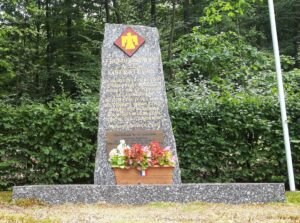
Among them was Steve C. Reyka who served as an H Company heavy machine gun crewmember and joined the battalion in Italy.
In the first week of October 1944, in the dense forests of the Vosges Mountains, 2nd Battalion, 180th Infantry Regiment, teetered on the brink of total annihilation. German troops and tanks surrounded all three of its rifle companies, along with their H Company heavy weapons attachments. Supply routes and communication lines had been severed by intense artillery and tank shelling.
Most of an entire infantry company, along with its heavy weapons attachments, was captured in that forest. The remaining two battalion companies, E and G, lost more than half of their men in hand-to-hand combat after exhausting their ammunition. After fighting throughout the day and night they attempted to fight back through to their own lines through the dark woods, encountering enemy strongpoints and firefights in the darkness, only to find enemy troops using 180th’s foxholes.
With the other survivors of the battle, Reyka fought his way back through enemy lines. He managed to avoid capture, but he left something behind in that dark forest and never spoke of his experiences.
In an effort to better understand his father, Michael Reyka undertook an 8-year project to uncover his father’s legacy, culminating in a journey tracing his father’s unit journey through France. Michael shares some of the highlights of that journey as detailed in his book “Stand of the Thunderbirds: 180th Infantry Regiment and the Battle of Fremifontaine”.